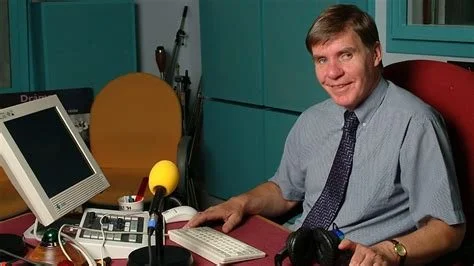
Transcript of Culloden Memorial Talk, by Coinneach ‘Mòr’ MacÌomhair, April 2026.
Cullodair. 2026
‘S e urram mòr a th’ann dhomh a bhith an seo an-diugh.
Moran taing airson a' chothruim seo a thoirt dhomh.
‘S e àite cudromach, samhlachail a tha seo dhuinn uile.
Culloden. This is an important and symbolic place for us all.
‘S e iongantas a th’ann dhomh fhèin a bhith an seo an-diugh – agus a bhith a’ bruidhinn ribh nam chainnt mhàtharail - a’ Ghàidhlig.
It is a remarkable thing that I can stand here today and begin by speaking to you in Gaelic - my mother tongue.
Smaoinich an-dràsta air an fheadhainn a dh’fheuch ri Gàidhlig a mhùchadh air an làrach seo bho chionn 280 bliadhna. Dh'fheuch iad ri crìoch a chur air dòigh beatha - cànan, cultar, fèin-aithne nan Gàidheal - an seo. Nan cluinneadh iad i air a bruidhinn thar achaidhean Chuil Lodair - an-diugh ann 2026 – saoil dè chanadh iad?
This place marks more than a battle.
It marks a deliberate attempt to dismantle a way of life – the language, the culture and the identity of the Gaels.
On that historic day – 16th April 1746 - it was a victory for King and Crown. But the legacy of Culloden lingered well into the 20th century. There are still with us some whose parents were punished - belted - for speaking their own native language in the playground. The impact of Culloden is not distant history.
What followed the battle was something deeper and longer-lasting than the wounds left by the sword and the spear. The oppression of the Gaelic language. The marginalisation of our culture. The sidelining of our identity. In the traditional Gaelic speaking areas – the Gàidhealtachd - in the very communities where Gaelic was once heard in every home numbers are falling. Populations are declining. Schools are closing. Houses stand empty for much of the year.
But the battle is not over.
The fact that I can stand in front of you today and speak more comfortably in the language of the losing side than in this one, shows that the longer battle is still being fought.
We are often told that Gaelic is in decline. And yet, the most recent census tells a more complex story. Across Scotland, the number of people with Gaelic skills has increased. More young people are learning, more families are choosing Gaelic medium education, and in our cities in particular we are seeing real growth. This, in itself, is a wonder. We hear that it is a waste of time, a waste of resources – whether that is Gaelic in schools, or something as visible as bilingual signage. Ach - tha iad seo cudromach. But - these things matter.
There are many who see our supporting our language and culture as irrelevant to today’s world. In many ways, the effort to suffocate our language has succeeded. Communities that once lived naturally through Gaelic no longer do.
But that is not the whole story.
We have in recent times seen a reversal of what once seemed inevitable. A new generation has emerged which understands that without the language, the key to a people and a culture is lost. Culloden is seen as the end of one world and the beginning of a different world. It is of course not as simple as that. We find ourselves in a position that would once have seemed unlikely. A language growing in places where it was once weak, and weakening in the place where it was once strongest.
At times people coming from other parts see the merit of holding on to our language and culture, while many of our own people now do the work of Culloden and see it as of no relevance , a waste of time and money. It has been a struggle to maintain our culture our music and our language in the face of, at many times, establishment indifference and opposition. Education tried to eradicate my language. Many people who did and do speak it better than I do are illiterate in Gaelic. It was hardly taught in schools. Thankfully, it is in spite of this continued opposition, that there is now a more enlightened approach. Gaelic medium education is fast becoming the foundation of a renewed cultural confidence and a symbol of resilience.
The opposition voices are not so vocal at present but be under no illusion they are still there. Ask anyone involved in Gaelic language schools and they will tell you. Resentment amongst monolingual teachers and parents exists, occasionally coming to the surface. Maybe not so often in the present political climate as in the past.
To some it might seem trivial and a waste of resources to have our road signs in Gaelic as well as English. To me it is a symbol to indicate that people are coming to a part of the world which is different and has an identity which for a long time Culloden and its aftermath seemed to have completely suffocated and killed off.
Thankfully we live in slightly more enlightened times.
My three children were taught through the medium of Gaelic. I did not have that opportunity. It didn’t just happen though. I remember us taking the children to the Council chamber when it seemed that tokenism ruled and that our children were only going to be taught through Gaelic for a maximum of three years. I remember us having to paste text on to schoolbooks as there were so few available in Gaelic. That has all changed. There are now many good resources in the many Gaelic medium schools throughout the country.
Culloden did not succeed although it very nearly did.
We now have to move it on and make sure that children see the language as part of their life outside school not just in the classroom. It is ironic that when it was the language of the playground it most certainly was not the language of education. Now we have to get it back into the playground. In the Gaelic speaking areas we have several challenges. We have declining populations. We no longer have the community activities that created our community. The peats, the potatoes , the fanks, where people gathered and sorted the world’s problems as they worked together. And of course all the talking, the arguing, the disagreements…. in Gaelic. We have many incomers who have no knowledge of our language and culture. We have houses that are empty most of the year. Many people who see the lack of economic opportunities as far more important than fighting what might still seem to be a losing battle. Look at the Faroes. Increased economic activity at the beginning of the 20th century led to a gaining of self confidence and the revival of a language which was in its last legs.
A big problem is our declining school roles in our rural areas. As an example…. in my wife’s district in Lewis her local school had about 30 pupils when she went to school. There were 5 schools in the area 50 years ago. They are all closed apart from one, which has 5 pupils. A huge challenge for our language and culture. Thankfully the former barren grounds of our cities have seen what we were losing and now have considerable numbers of children being brought up and educated through Gaelic.
The Battle of Culloden was fought and lost …the War of Culloden is still with us, but we are still here but so are they who would like to see us gone.
Tha e math a bhi comhla ruibh. It is good to be with you.
Se urram a th’ann cothrom a bhith agamsa facal neo dha a radh an seo an diugh.
It is an honour for me to have this opportunity to share these few thoughts with you here today.
It has been an honour to share these words with you. The very organisation of this event stands as proof that, despite the Crown’s intentions at Culloden, we – na Gàidheil - are still here all these centuries later. Our language is still here. Our story continues.