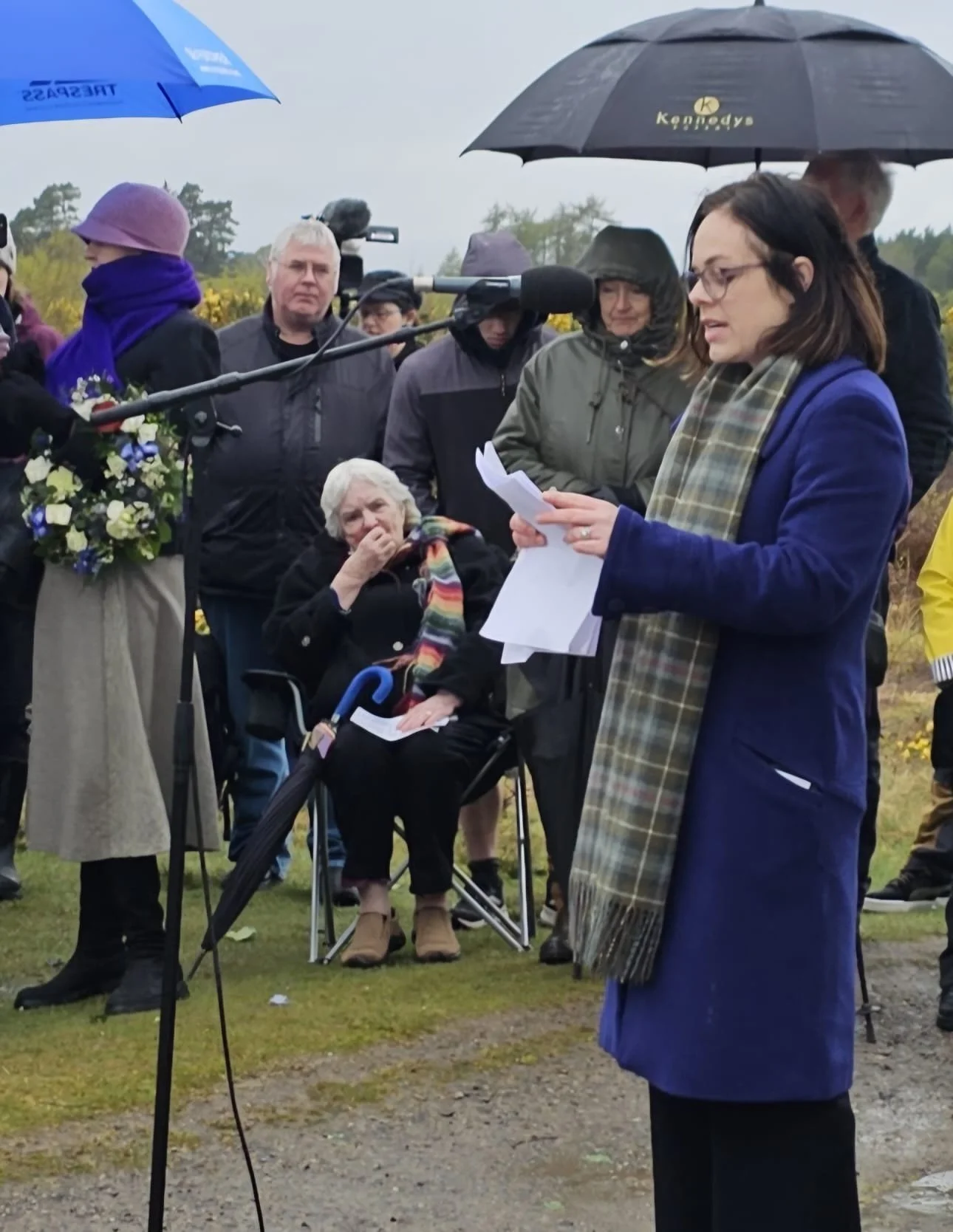
Deputy First Minister Kate Forbes
Speech for Culloden Memorial Service –
19 April 2025
Madainn mhath dhuibh uile.
’S e urram a tha ann do Ghàidheal sam bith a bhith a’ toirt seachad na h-òraid seo aig seirbheis cuimhneachaidh Chùil Lòdair. ’S e urram a tha ann buileach a bhith ga toirt seachad is sinn a’ comharrachadh aon cheud bliadhna bhon a chaidh an t-seirbheis a cumail airson a’ chiad uair. Mo thaing do Chomunn Ghàidhlig Inbhir Nis airson a’ chothroim seo. Mo thaing don Chomunn agus cuideachd do Urras Nàiseanta na h-Alba airson an dìcheall leis a bheil iad a’ cumail na seirbheis suas gach bliadhna agus a’ glèidheadh cuimhne Chùil Lòdair san latha an-diugh.
Good morning everyone.
It is an honour for any Highlander and any Gaelic speaker to be asked to deliver this speech at the Culloden Memorial Service. It is especially an honour to be delivering it as we mark one hundred years since the first such ceremony. My thanks to the Gaelic Society of Inverness for this opportunity. My thanks to the Society and to the National Trust for Scotland for their efforts each year in maintaining this ceremony and preserving the memory of Culloden in the modern age.
When we talk about Culloden, the modern age is the key term. Historians comment on the place which this particular battle holds in the cultural memory. Beyond the devastation of the conflict itself, no single event did more to precipitate the forces which would shape the Gaelic and Highland experience of the modern age. The debate over Gaelic’s position as a minority language in an increasingly integrated society, and the debate over the Highlands as a regional economy in a globalising world, serve as binding themes which connect 1745 to 2025. Albeit this is a debate which in the present day occurs within a mercifully more tolerant politics – and one in which we can discern an increasingly widespread recognition that multilingualism is a national asset and that the past treatment of Gaelic is a wrong in need of redress.
In speaking here today, it is an honour to be able to follow some of the great modern scholars of Gaelic literature and culture: individuals such as Catriona Murray, Jo MacDonald and Hugh Cheape. Through efforts such as theirs our understanding of the Gaelic past has been immeasurably improved. This in turn allows us to build Gaelic’s future. A key argument in contemporary Gaelic policy is that cultural revival within Gaelic communities is also an agent in their social and economic regeneration. I can think of no better rebuke than this to the ideology which would be unleashed upon the Highlands in the aftermath of Culloden and to which this battlefield bears witness.
The establishment of this memorial service a century ago was itself an early part of the modern movement to secure Gaelic’s place in Scottish life – a movement which would find such success in the latter half of the 20th century. Speakers in previous years have paid testatment to the transformation in national attitudes towards the language – a development which is still very much within living memory. This transformation was marked by the full establishment of Gaelic education, the encouragement of Gaelic media, literature and arts, and the passing of the Gaelic Language Act. I am proud that the Scottish Government is building on these efforts through the Scottish Languages Bill.
Such provision on behalf of Gaelic by the state would have been unthinkable to those such as Alasdair Mac Mhaighstir Alasdair or Donnchadh Bàn Mac an t-Saoir who fought on different sides at Culloden and chronicled the language’s fortunes in its aftermath.
We owe much of our knowledge of their work and the deeper Gaelic experience at Culloden to John Lorne Campbell’s pioneering work, Highland Songs of the ’45 – itself published less than a decade after the first Culloden memorial service. In their life and work, John Lorne Campbell and his wife Margaret Fay Shaw demonstrated how the preservation of historical memory, contemporary cultural revival and rural economic development could work together in the service of greater prosperity.
To a great extent, these are among the general principles informing Gaelic development in the present day. They can be seen at work whether in the activities of a national organisation like Bòrd na Gàidhlig, an institute of higher learning like Sabhal Mòr Ostaig, or a regional development body like Highlands and Islands Enterprise. Integral to the work which is pursued by them and other organisations across Scottish life, however, are the communities which we all serve and whose wellbeing provides the foundation of national wellbeing.
In her address to the 2023 memorial service, Catriona Murray referred to “a certain trepidation” which was felt across the Gaelic world as we awaited publication of the speaker figures from the 2022 Census. A year on from the release of the census figures, we can reflect positively upon the fact that they showed an increase in the number of Gaelic speakers. However, this is a reflection which must also take heed of the challenges still faced by Gaelic – not least in the rural, island communities in which it is still a major language of daily life. While these challenges remain the trepidation mentioned by Catriona will also remain.
The census is itself a product of the industrial state and modern economy which emerged across the British Isles in the generations following Culloden. Alasdair Mac Mhaighstir Alasdair and Donnchadh Bàn, like any other Scot of their age, would have been astonished by the instruments of national quantification which shape public life in the 21st century. Most astonishing for them, however, would be that one of those instruments – the Scottish Social Attitudes Survey – would find that four in every five Scots viewed Gaelic as an important aspect of their heritage.
As we face the challenges still before us, and reckon with the deeper history that shaped them, it is vital to acknowledge how far we have come—and to use that understanding to guide our path forward.
Another one of my predecessors in this office, the great Sgitheanach Murdo Beaton, concluded his speech with the following statement:
Tha e ceart agus iomchaidh gu bheil sinn a’ coimhead air ais agus a’ cuimhneachadh, ach bitheamaid cuideachd a’ coimhead air adhart le dòchas agus deagh mhisneachd.
It is right and proper that we look back and remember, but we must also look forward with hope and great encouragement.
I echo this sentiment and regard it as the most fitting way to approach the commemoration of a battle such as this and the episodes in our history which it evokes. In Gaelic we talk of putting a “clach air a’ chàrn” – placing a stone on the cairn. I hope that the stone which is placed in memorial to the past can also serve as a foundation for building towards the future.